
NEWS CENTER
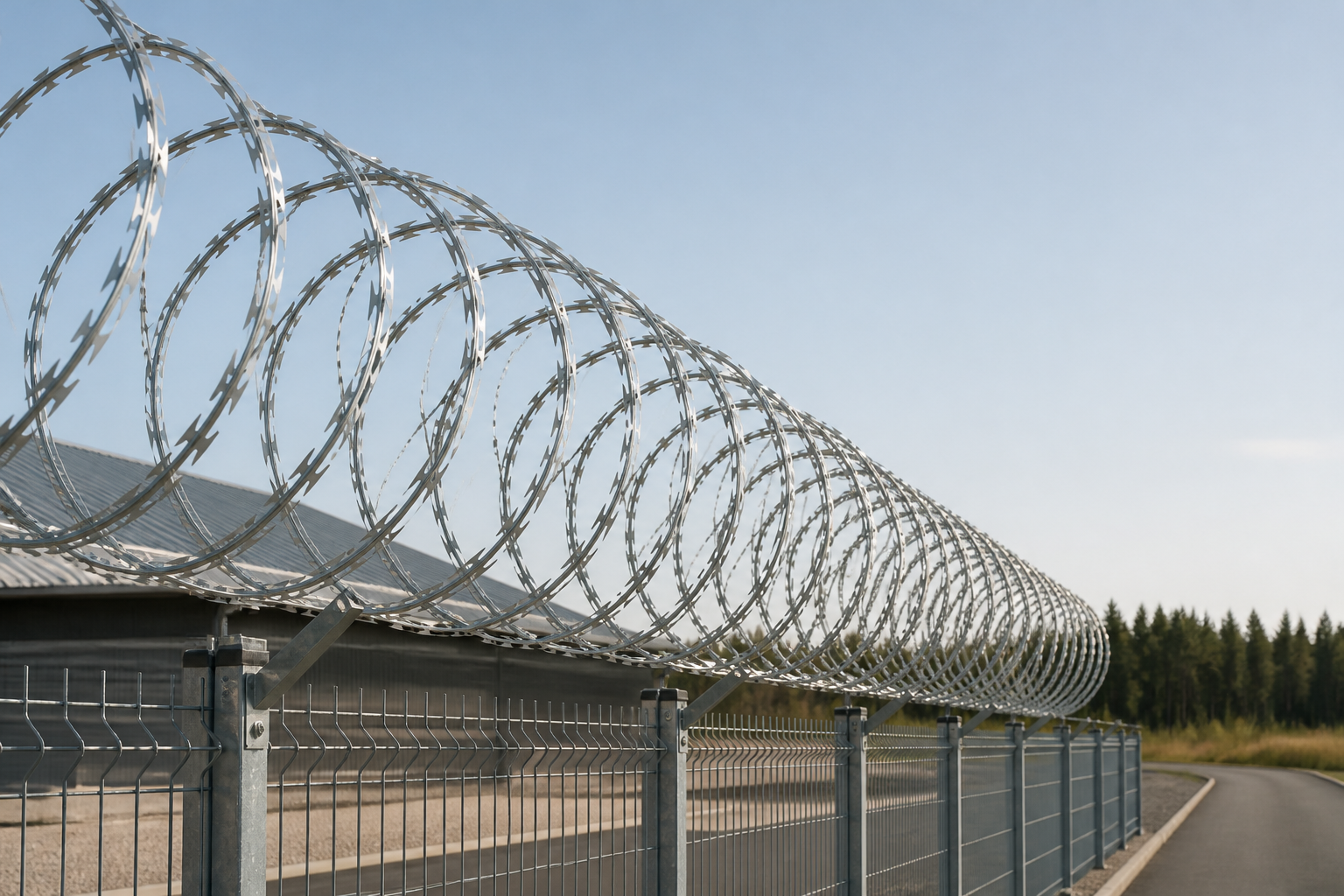
How to Choose Razor Barbed Wire: A Buyer's Guide to Blade Types, Coil Sizes and Coatings
Short answer: To choose razor barbed wire, fix four parameters in this order — blade type and size (BTO for general perimeter work, CBT for high-security sites), core wire and blade thickness (2.5 mm core wire with a 0.5 mm blade is the industry default), coil diameter and loop count (450–500 mm for wall-top mounting, 900–980 mm for ground-level barriers), and coating (hot-dip galvanised for inland sites, stainless steel for coastal or chemical environments). Get those four right, then confirm clip count, loop pitch and packing before you place the order.
Most buyers get this backwards: they ask for a price per roll first and a specification second. That order guarantees mismatched lots, sagging coils, and a second order to fix the first one. This guide walks through the decision in the sequence that actually prevents costly mistakes.
What Razor Barbed Wire Actually Is
Razor barbed wire — also called razor wire, concertina wire, or barbed tape — is a security barrier made from a stamped steel blade strip crimped around a high-tensile core wire. Unlike traditional barbed wire, which uses twisted wire points, razor wire uses continuous sharp-edged blades, which makes it far harder to climb, cut, or push through.
It is normally supplied as a concertina coil — a helical spring that expands along a fence line, wall top, or open ground — or as a flat wrap that lies against an existing fence panel.
Typical deployment: military and government installations, prisons and detention centres, border control, substations and utility compounds, ports and logistics yards, industrial plants, and high-value residential perimeters. Local planning rules often restrict its use in residential areas, so confirm zoning before specifying it for a residential site.
Step 1 — Match the Blade Profile to the Threat Level (BTO vs CBT)
This is the single most consequential decision, and the one buyers most often get wrong.
BTO series — flat, straight-stamped single blade. BTO stands for barbed tape obstacle. The number is the blade length in millimetres: BTO-10, BTO-12, BTO-15, BTO-18, BTO-22, BTO-25, BTO-28, BTO-30. BTO-22 is the global workhorse — it balances deterrence, weight and cost.
CBT series — crossed (X-profile) blade with two cutting edges, usually CBT-60 or CBT-65. The longer, crossed blade creates a denser cutting field and is specified where the barrier must be genuinely impassable rather than merely discouraging.
Rule of thumb: if the site is guarded and the barrier only needs to slow an intruder down, BTO-22 is the cost-efficient answer. If a breach would be a national-security or life-safety event, specify CBT-60/CBT-65 and accept the higher unit weight and price.
Step 2 — Fix the Core Wire and Blade Thickness
Two numbers decide whether the coil holds its shape under load:
- Core wire diameter. The industry default is 2.5 mm high-tensile wire, with a tolerance of about ±0.1 mm. Anything below 2.2 mm on a large-diameter coil will stretch and sag. Note that some suppliers reduce the core wire to shave cost — this is invisible in a photo and obvious only once the coil is installed.
- Blade thickness. BTO blades are typically 0.5 mm; CBT blades typically 0.6 mm. The commercial-grade range runs from about 0.45 mm to 0.65 mm. Thinner tape is cheaper per roll but stamps with a less durable edge and tears more easily during installation.
Ask for the tolerance, not just the nominal figure. A "0.5 mm" blade that ships at 0.38 mm is a different product.
Step 3 — Choose the Coil Diameter and Loop Count
Coil diameter determines how the barrier is mounted and how much ground it covers:
Loop count matters as much as diameter. The spacing between turns should not exceed roughly 390 mm — beyond that the coil loses rigidity and the barrier can be pushed apart. When no spacing is specified, suppliers commonly calculate on a 300 mm pitch, which works out to roughly 3.3 loops per metre of fence line.
This is also where the cheapest quotes hide a specification cut. A coil built with 3 clips per loop is acceptable at 500–600 mm diameter, but on a 900 mm coil it produces a barrier that is visibly weaker — the coil flexes and gaps open under load. Always confirm 3-clip vs 5-clip in writing.
Step 4 — Pick the Coating for Your Climate
For a substation in a dry inland province, hot-dip galvanised is the right answer. For a port perimeter or an offshore-adjacent site, specify stainless and treat the extra cost as insurance rather than an upgrade.
Step 5 — Calculate How Much Razor Wire You Actually Need
Suppliers quote razor wire by roll weight (a standard roll is 10 kg), not by metre — so convert before you compare prices.
Method:
- Decide the coil diameter and loop pitch (e.g. 500 mm coil, 300 mm pitch).
- Calculate loops needed: loops = fence length (m) ÷ 0.30 m. A 100 m run at 300 mm pitch needs about 333 loops.
- Ask each supplier for the expanded (stretched) length per 10 kg roll at that diameter and blade type.
- Calculate rolls: rolls = fence length (m) ÷ expanded length per roll (m), then add 5–10% for overlaps at corners, gates and direction changes.
Because expanded length per roll changes with blade thickness, core wire diameter and loop count, it is a supplier-specific figure. A supplier who cannot state it is a supplier who has not built the coil to a specification.
Always compare price per metre of installed barrier, not price per roll.
Step 6 — Run a 7-Point Quality Check Before You Pay
- Blade thickness — micrometer-measure at five points along the tape; expect the stated value ±0.05 mm.
- Core wire diameter — 2.5 mm ±0.1 mm, with no visible splices. Every joint in the core is a weak point.
- Clip count per loop — 3 or 5, stated in the contract. Five for coils of 900 mm and above.
- Zinc coating mass — request a coating-weight test result in g/m², not simply the word "galvanised".
- Stamping quality — clean, fully punched blades with no torn edges or half-formed points.
- Loop pitch consistency — measure across ten consecutive loops; sag or variance means the coil will open up in service.
- Packing — waterproof paper plus woven bag as a minimum; palletised and strap-banded for container loading. Poor packing is the most common source of arrived-damaged razor wire.
For orders above one container, add a third-party pre-shipment inspection and a mill test certificate to the contract.
Razor Barbed Wire vs Traditional Barbed Wire
The cost comparison is misleading if made per metre of wire rather than per metre of fence line: razor wire frequently replaces two or three rows of barbed wire, which changes the total project cost calculation.
What Drives the Price of Razor Barbed Wire
Buyers are usually surprised that two "BTO-22, 10 kg, galvanised" quotes can differ by 40%. The gap almost always sits in one of these six places:
- Blade thickness — 0.45 mm vs 0.5 mm vs 0.6 mm tape stock.
- Zinc coating weight — the bottom of the 50–275 g/m² range versus the top.
- Core wire grade — high-carbon high-tensile versus low-carbon wire.
- Clip count and loop pitch — 3-clip versus 5-clip construction.
- Stainless versus galvanised — a step change, not a marginal one.
- Packing and freight — waterproof paper and woven bag, palletising, and how close the factory sits to a port.
A supplier located close to a major export port can hold a genuine cost advantage at the same specification, because inland freight to the port is part of your delivered price.
Frequently Asked Questions
What is the most common razor barbed wire specification? BTO-22 with a 0.5 mm blade, 2.5 mm core wire and a 450–500 mm coil diameter, supplied as a 10 kg roll, hot-dip galvanised. It is the default for industrial, utility and commercial perimeter fencing worldwide.
What is the difference between BTO-22 and CBT-65? BTO-22 uses a flat, single-stamped blade 22 mm long on a 2.5 mm core wire. CBT-65 uses a crossed X-profile blade 65 mm long on a heavier core wire, roughly 0.6 mm thick. CBT-65 is specified for prisons, borders and military installations; BTO-22 covers most other perimeter security work.
What coil diameter should I choose? Use 450–500 mm on top of walls and fences, 600–700 mm for taller fence extensions, and 900–980 mm for ground-level standalone barriers. Larger coils need 5 clips per loop to hold their stiffness.
How much razor wire do I need per metre of fence? Calculate loops at roughly a 300 mm pitch, which is about 3.3 loops per metre. Then convert to rolls using the supplier's expanded length per roll at your chosen diameter — a 10 kg roll covers a supplier-specific length, so always compare cost per metre of barrier rather than cost per roll.
Is galvanised or stainless steel razor wire better? Hot-dip galvanised is the correct and most economical choice for inland and moderate climates. Stainless steel 304 or 316 is the right answer for coastal, marine and chemical environments, where the galvanised layer would be consumed quickly.
How do I stop razor wire from sagging after installation? Specify a 2.5 mm core wire, a loop pitch no greater than about 390 mm, and 5 clips per loop on coils of 900 mm or larger. Sag almost always traces back to a lightweight core wire or a 3-clip coil used on a large diameter.
Can razor barbed wire be PVC coated? Yes. PVC-coated razor wire is available in green, blue, yellow and black, and is used where colour matching or a slightly less aggressive visual appearance matters. The PVC jacket sits over the galvanised layer — it does not replace it.
Do I need approval to install razor barbed wire? Often, yes. Many jurisdictions restrict razor wire in residential areas through planning or zoning rules, and installations near public footpaths typically require warning signage. Check local regulations before specifying it.
Choosing a Razor Barbed Wire Supplier
Five things separate a reliable supplier from a broker:
- They state tolerances, not just nominal figures.
- They can quote zinc coating mass in g/m² and provide a test report.
- They confirm clip count and loop pitch in the quotation.
- They can supply third-party inspection and a mill test certificate.
- They are located close to an export port, which shows up in your delivered price.
Shandong Zhongsheng Materials Co., Ltd. manufactures and exports razor barbed wire from Jinan, Shandong, with nearly 20 years of steel production, processing and sales experience and annual sales above 300,000 tons. The company sits adjacent to the Tianjin and Qingdao ports, which keeps inland freight to port low. Razor barbed wire is available galvanised, stainless and PVC-coated, in 10 kg concertina coils and strand form, with samples available for specification approval — view the razor barbed wire range or request a quotation.

Fill in the information
NOW.
Our staff will contact you as soon as possible