
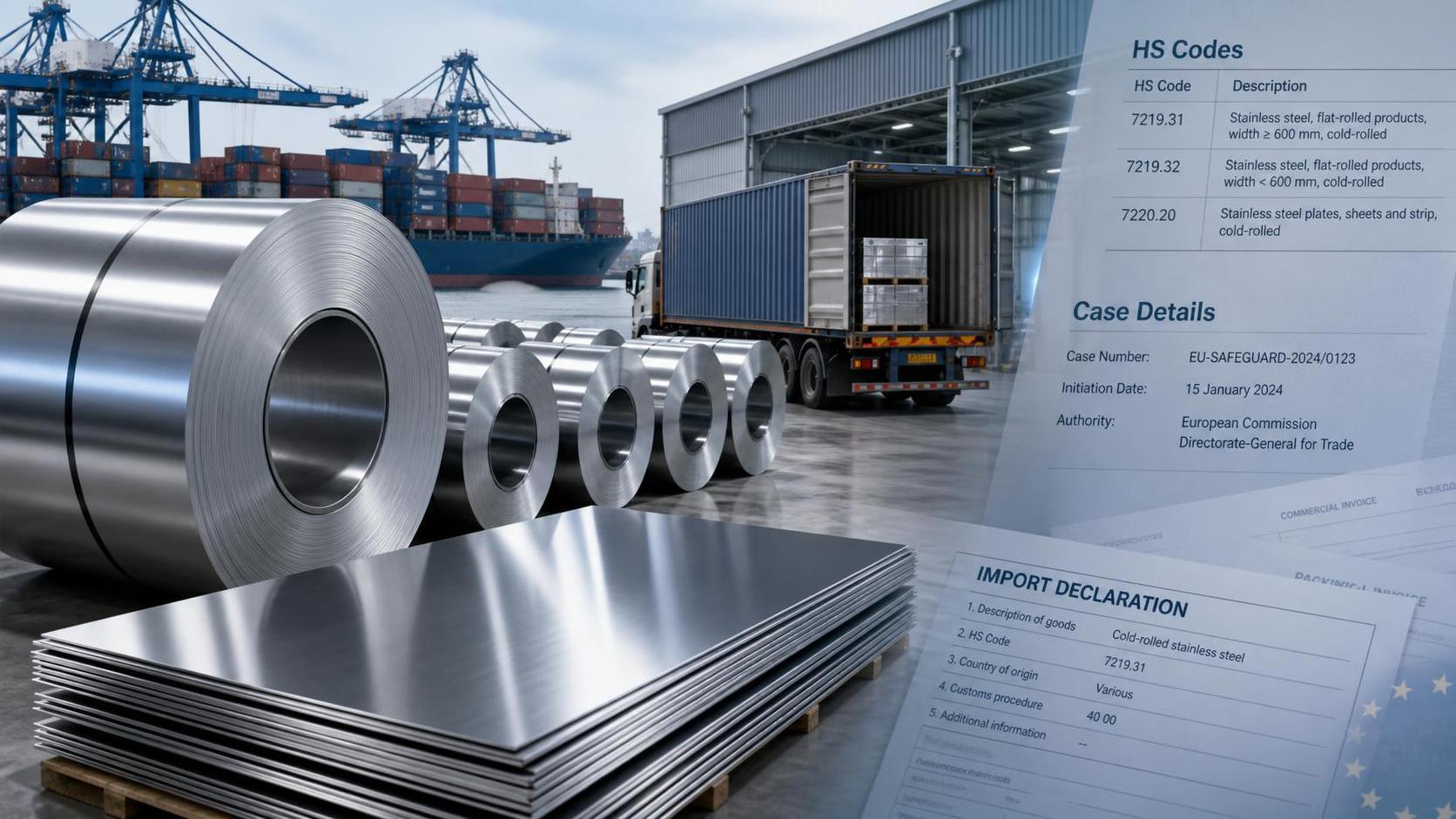
The European Commission opened a countervailing investigation on 6 August 2026 into cold-rolled stainless steel coils from China, covering HS codes 721932, 721933 and 721934. Exporters involved are required to submit questionnaires within 30 days. For buyers, importers, and downstream users tied to European curtain walls, home appliances, and new energy equipment, the case is worth close attention because it may reshape landed costs, customs clearance assumptions, and distribution margins.
What the Commission has opened
The European Commission formally announced a countervailing investigation on 6 August 2026 under case number EU/CS/2026/08-01. The products under review are cold-rolled stainless steel coils from China, classified under HS codes 721932, 721933 and 721934. According to the announcement, exporting companies involved in the case must submit their questionnaires within 30 days. The stated downstream use of the product includes European building curtain walls, household appliances, and new energy equipment manufacturing.
Where the pressure may be felt first
Importers and direct traders
Importers and direct traders are the first parties likely to face commercial pressure if additional duties are eventually imposed. The main effect would appear at customs clearance and in landed cost calculations, which in turn affects resale pricing and margin control. The event also raises the importance of shipment timing, contract terms, and whether existing orders can absorb a future cost change.
Downstream manufacturers and fabricators
For manufacturers that use the product as an input, the key issue is procurement continuity. If the investigation later leads to additional duties, sourcing plans, inventory decisions, and customer quotations may all need adjustment. This matters most for businesses that rely on stable input pricing for facade systems, appliance components, or equipment manufacturing.
Distribution and supply-chain service providers
Distributors, logistics operators, and customs service providers may also see operational adjustments. Their exposure is less about the duty itself and more about document handling, clearance timing, and transaction planning. When a trade remedy case is active, the quality of product classification and trade documentation becomes more important in day-to-day execution.
What companies should watch next
Track the official case process closely
The immediate practical point is the case timeline. The questionnaire deadline is fixed at 30 days for the exporters involved, so the next official steps will matter more than market speculation. Any later public detail on scope, procedure, or preliminary findings should be checked directly against official case documents.
Review HS classification and contract exposure
Companies trading these products should verify whether their goods fall under HS codes 721932, 721933 or 721934. They should also review customer contracts, quotation validity, and delivery schedules so that any future duty change does not create avoidable disputes over price responsibility.
Prepare customs and communication files in advance
For businesses with active shipments or pending orders, it is sensible to keep product descriptions, origin records, and transaction documents organized early. That is especially relevant for importers that may need to explain cost changes to buyers or reschedule deliveries if the case develops further.
How to read this signal now
Analysis shows this is best understood as an active trade-remedy signal rather than a final market outcome. The investigation itself is confirmed; the broader commercial impact depends on how the case develops and whether additional duties are eventually imposed. At this stage, what matters is not only the product category, but also the way the case may affect customs costs, pricing discipline, and procurement planning across the chain.
What the market should take from it
From an industry perspective, the case is important because it links a specific stainless steel product category to several downstream European applications at once. That makes the development relevant to exporters, importers, distributors, and end users alike. It is more appropriate to treat this as a live regulatory development that still requires follow-up, not as a settled pricing or trade result.
Source note and follow-up
This article was generated based on the user-provided title, event date, and event summary. Relevant source types for this kind of update typically include official Commission notices, company statements, industry association updates, and authoritative media coverage. A specific official source link was not provided in the input, so the underlying announcement still needs to be verified against the original Commission publication and any subsequent case documents.

Fill in the information
NOW.
Our staff will contact you as soon as possible